Thursday, March 22, 2018

Cabinet clears Ayushman Bharat -National Health Protection Mission

This scheme will offer health cover of Rs 5 lakh per family per year to 10 crore families.

The cabinet on Wednesday approved the centrally-sponsored Ayushman Bharat-National Health Protection Mission (AB-NHPM), which will provide a health insurance cover of Rs 5 lakh per family per year.
The intended beneficiaries of the proposed scheme will be more than 10 crore poor and vulnerable families, based on the Socio Economic and Caste Census (SECC) database.
The existing Rashtriya Swasthya Bima Yojana (RSBY), which provided a health cover of Rs 30,000, and the Senior Citizen Health Insurance Scheme (SCHIS) will be subsumed into the new scheme.
Although the government has not specified an exact date for the introduction of the scheme, sources told Moneycontrol that a formal launch will be done on August 15.
The AB-NHPM was first announced by finance minister Arun Jaitley in his Union Budget speech this year.
A government statement said this cover will take care of almost all secondary care and most tertiary care procedures.
"To ensure that nobody is left out (especially women, children and elderly) there will be no cap on family size and age in the scheme. The benefit cover will also include pre and post-hospitalisation expenses. All pre-existing conditions will be covered from day one of the policy," the government said in the statement.
At present, most insurance policies exclude all pre-existing conditions of individuals in health insurance products.
The AB-NHPM will also have a defined transport allowance for every time a person is hospitalised, which will be paid to the beneficiary.
It is estimated that the government will need between Rs 20,000 crore and Rs 25,000 crore to implement the scheme.
AB-NHPM will be an entitlement-based scheme with entitlement decided on the basis of deprivation criteria in the SECC database.
The different categories in rural areas include families with only one room with kucha walls and kucha roofs, families having no adult member between age 16 to 59, and female-headed households with no adult male member between age 16 to 59, among others.
Also, families with disabled members and no able-bodied adult member, SC/ST households, and landless households deriving major part of their income from manual casual labour, will be entitled under the scheme.
For urban areas, 11 defined occupational categories are entitled under the scheme. The beneficiaries can avail benefits in both public and empanelled private facilities.
All public hospitals in the states implementing AB-NHPM will be deemed empanelled for the scheme. Hospitals belonging to Employee State Insurance Corporation (ESIC) may also be empanelled based on the bed occupancy ratio parameter.
As for private hospitals, they will be empanelled online based on defined criteria.
In terms of the mode of implementation, state governments will be allowed to expand AB-NHPM both horizontally and vertically. They can implement it through an insurance company or directly through a trust/society or a mixed model.
However, it is likely that most states will employ an insurance model wherein companies will be chosen through a process of tender.
To ensure that the funds reach state health agencies (SHAs) on time, the transfer of funds from the central government under AB-NHPMA to the SHAs will be done through an escrow account directly.
In partnership with NITI Aayog, an IT platform that will entail a paperless, cashless transaction will be made operational.
In the initial stages, outpatient expenses will not be covered under the scheme and only in-patient hospitalisation expenses will be covered.
Data showed that rural households primarily depended on their household income/savings (68 percent) and on borrowings (25 percent).
However, urban households relied much more on their income/saving (75 percent) for financing hospitalisation expenses, than on borrowings (18 percent).
Out of pocket (OOP) expenditure for healthcare in India is over 60 percent, which leads to nearly 6 million families slipping into poverty due to catastrophic health expenses. The AB-NHPM is expected to have an increased benefit cover for nearly 40 percent of the country's population.

Tuesday, January 16, 2018

Banks must learn to manage rate risks, RBI cannot always bail them out: Dy Guv Acharya

Banks must not be surprised but understand the risks in the bond markets well and that central bank will not intervene to bail out banks from adverse interest rate movements, Reserve Bank of India (RBI) Deputy Governor Viral Acharya said.

Banks must not be surprised, but understand the risks in the bond markets well, said Reserve Bank of India (RBI) Deputy Governor Viral Acharya, even as he noted the central bank will not intervene to bail out banks from adverse interest rate movements.
Banks are set to witness heavy treasury losses amounting to anywhere between Rs 15,000 - 25,000 crore in the third quarter results after the bond yields collapsed about 67 basis points in the December quarter.
However, in a strong message, Acharya said “Interest rate risk of banks cannot be managed over and over again by their regulator."
In a speech at the annual dinner of the Fixed Income Money Markets and Derivatives Association (FIMMDA), the RBI deputy governor indicated this was not the first time when bond yields have risen. But banks have not been much wiser; rather, they tend to ignore the risk. “… banks should not be surprised repeatedly when government bond yields rise sharply and their investment profits drop."
Having started reporting the results this month, banks have asked RBI to allow spreading of the provisions on the losses to avoid taking an immediate hit on their profitability.
It has been a common practice among Indian banks to seek relaxation whenever they were in losses, and the regulator in the past has largely obliged.
However this time, Acharya threw the ball in the treasury departments' courts speaking to the association of bond investors, most of them being from banks, saying instead of praying for regulatory relaxations they should equip themselves with derivative products.
“The regulator, in the interest of financial stability, is caught in such situations, between a rock and a hard place, and often obliges,” Acharya said.
However, he added, "By taking advantage of the dispensation regularly, efficient price discovery in the government securities (G-Sec) market and effective market discipline on the G-Sec issuer was not happening. “Nor does it augur well for developing a sound risk management culture at banks.”
According to him, the excess liquidity in the banking system did not get absorbed through the RBI’s liquidity operation, and capital-starved banks parked the funds in bonds, at the expense of duration risk.
He said, "With relatively high duration and concentration of G-Secs in investment portfolio, bank earnings and capital remain exposed to adverse yield moves."
As a result, the size of banking sector's balance-sheet exposure to G-Secs, and hence, its interest rate risk, is high in an absolute sense, and is relatively elevated, when measured in proportion to total assets, for public sector banks relative to private banks.
RBI’s Financial Stability Reports (FSR) have regularly pointed out the impact of such large interest rate moves on capital and profitability of banks, said Acharya. "Banks should know and understand this risk rather well. Perhaps they do, and the issue is really one of incentives that lead to their ignoring this risk.”
And the incentive was to line up to the regulator to give regulatory compensation, which, Acharya described as “heads I win, tails the regulator dispenses.”
The share of commercial banks in outstanding Government Securities (G-Secs) was around 40 percent as on June 2017, while investment of banks in G-Secs as a percentage of their total investment was around 82 percent for FY 2016-17.
The corresponding figure for public sector banks for 2016-17 was slightly higher at 84 percent.
In spite of the relative stability of the consolidated debt to gross domestic product (GDP) ratio of the government, the investor base for G-Secs in India was primarily limited to domestic institutions, which often resulted in oversupply of bonds in the market, Acharya pointed out.

Sunday, January 14, 2018

Friday, January 12, 2018

Perfect Stock Tip Today


Ace Investment Advisory's research based Indian Stock Tips  trading call TATAELXSI closed on 11.01.2018 at 1038.10. Buy TATAELXSI on 12.01.2018 above 1038.10 with strict Stoploss below 1029 fot intraday Target 1049 and 1058.Indian Stock Tips

Thursday, January 11, 2018

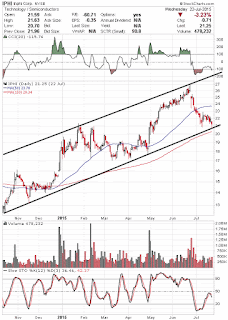
Channeling Stock Pattern

Channeling Stocks

Channeling stocks are stocks that have a strong tendency to trade between a support and resistance.  The distance between the support and resistance makes the stock appealing to channeling stock traders.
The difference between support and resistance typically needs to be at least 10% to 15%. Preferrably, 20% or more.
 Channeling Stock Pattern

Best Stock Tips Provider in India  http://bit.ly/2mh6QT2

Wednesday, January 10, 2018

Bull Flag Pattern

The bull flag pattern is probably the most bullish chart pattern you can trade.  As the name suggests, it looks like a flag pole with a flag on the top portion of the pole. 
To form the pattern, the price rises substantially in a short period of time and then consolidates for generally a few days to a few weeks to form the flag portion of the chart pattern.
A true bull flag pattern often leads to a secondary move of similar magnitude.  The price often rises 15% to 50% or more in a short period of time IF the price breaks out of the top of the pattern.
Best Stock Tips Provider in India http://bit.ly/2EmLpqT

Sunday, December 31, 2017

Grow Your Investment in 2018


Best Stock Tips Advisory in India http://bit.ly/2C1OD5W

My Blog List

Sharemasterindia News